Inflation Cooled. The 30-Year Didn't.
On July 30 I told you to watch the gap between the 10-Year and the 30-Year. Today we got the first clean read on it, and the two ends of the curve went opposite directions on the same piece of news.
First, the Numbers — Straight Off the Wire
The July Consumer Price Index landed this morning. Prices rose 0.1% from June, running at a 3.4% annual rate, down from 3.5%. Core prices — stripping out food and energy — matched the consensus estimate too. Not hot. Not cold. Exactly what the market had already priced.
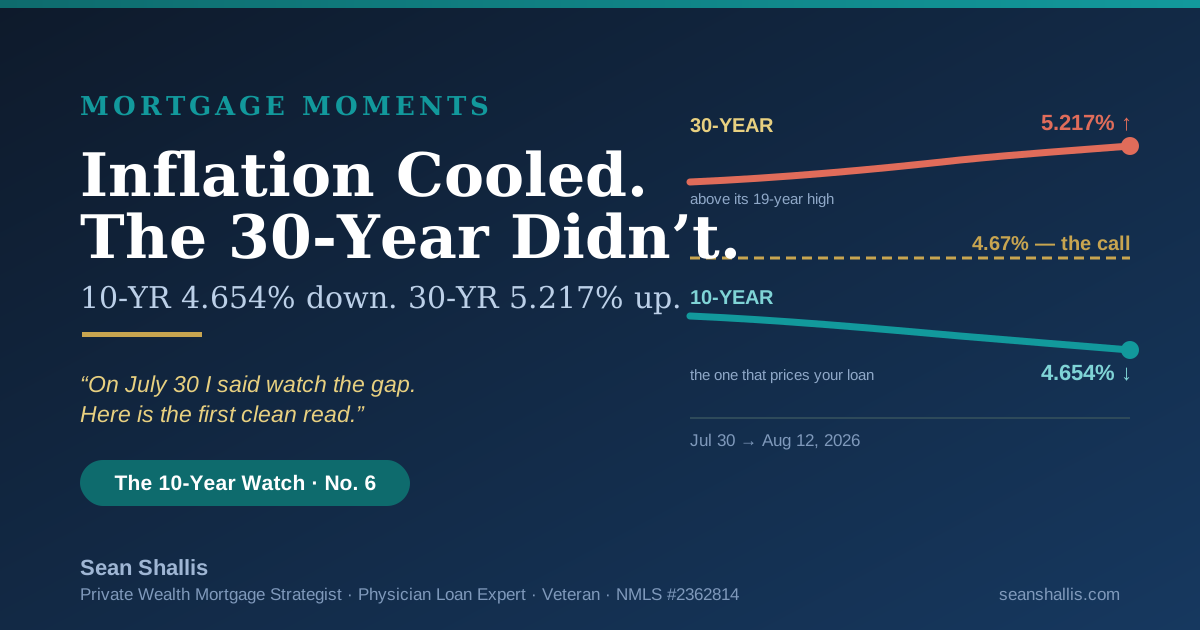
The bond market took it well at the short end. The 10-Year Treasury — the benchmark that actually drives your mortgage — eased about three basis points to roughly 4.654%. The 2-Year came off four, to around 4.178%. Both moved the way you would expect on a cooling inflation print.
The 30-Year ticked down too, by not quite two basis points, to about 5.217%. On the day, that is a decline. Hold that number still for a second, though, because the day is the wrong frame.
Market data as reported the morning of August 12, 2026. Not a quote, not an offer, not a prediction. These numbers move continuously and may have moved by the time you read this.
The Gap I Asked You to Watch
On July 30, in No. 5 of this series, I ended with a specific instruction rather than a forecast: watch the gap between the 10-Year and the 30-Year. That day the 30-Year printed 5.20%, which the coverage called a nineteen-year high, and I said the pressure behind it “does not stay politely in its own lane forever.”
Two weeks later, here is the read:
July 30 → today. Lower. Still under the 4.67% ceiling.
July 30 → today. Higher than the level that made a nineteen-year high.
So the honest sentence is not “the long end sold off today.” It did not. The honest sentence is this: across two weeks that included a cooling inflation report and a weak jobs report, the short end came down and the long end went up. Two pieces of news that should have helped both ends of the curve only helped one.
I said in No. 5 that I would not hide the argument against my own position in a parenthesis. This is that argument arriving on schedule. A 30-Year above a nineteen-year high, after data that should have pulled it down, is the bond market saying it is not finished worrying about long-run inflation — whatever the July CPI headline said.
What That Does and Does Not Mean for You
It does not mean your mortgage rate follows the 30-Year bond. It does not. I said so plainly two weeks ago and it is still true: your 30-year fixed prices off the 10-Year and mortgage-backed bonds, not the 30-year Treasury. Anyone flattening this into “rates hit a nineteen-year high” is telling you something false.
What it means is narrower and more useful. The part of the curve that prices your loan is behaving. The part that prices long-run inflation risk is not. Those two can disagree for a while. Historically they do not disagree forever.
Let Me Argue Against My Own Urgency First
Today's report was, on its face, good news for borrowers. Inflation cooled. Yields fell. A weaker jobs report last Friday already had investors leaning toward the Fed sitting still in September. If you want a case for waiting, it is not a stupid one, and I am not going to pretend otherwise to move you.
There is also a real cost to acting badly. Refinancing into a rate that barely beats your current one, and paying closing costs to do it, is how people lose money while feeling productive. A refinance that does not clear its own costs in a sensible number of months is not a win. It is a fee.
So no, I am not telling you the sky is falling. I am telling you what is on the calendar.
“In Line” Is Not a Green Light. It Is a Deferral.
Here is what an as-expected print actually does: it changes nothing, so it settles nothing. The market did not learn the answer this morning. It learned that the answer arrives later.
Ian Lyngen, who runs U.S. rates strategy at BMO Capital Markets, put it about as plainly as a strategist ever does: the release “leaves the path open for the Fed to pause in September, but is by no means definitive,” and “the September decision now comes down to the August payrolls and CPI combination.”
Read that as a borrower rather than a bond trader and it says something specific. The decision that prices your mortgage this autumn has been handed to a small number of reports that have not been written yet.
The three dates between here and September
- The July producer price index — Thursday. Wholesale inflation, two days from now. Last month's came in softer than expected.
- The August jobs report. July's came in weak, which is what pushed the September hike odds down in the first place. A strong August print pushes them back.
- The August CPI. The other half of Lyngen's pair. This is the one that lands closest to the meeting and carries the most weight.
None of these are my deadlines. They were on the economic calendar long before I wrote this, and they will land whether either of us does anything about them.
The Detail Almost Nobody Is Repeating
At the July meeting, with the target range at 3.50%–3.75%, three members of the committee dissented. They voted to raise.
That is not a rumour or a forecast. It is a recorded vote. And it is the single most useful fact in this entire report, because it tells you the direction of the risk is genuinely two-sided. The headline says inflation cooled. The vote says three people in the room were not convinced.
I have no idea which side is right. Neither does anyone quoting you a September forecast with a straight face. What I know is that a two-sided risk is exactly the condition under which being un-decided is itself a position — and most people holding that position have not noticed they are holding it.
What This Actually Means, Depending on Who You Are
If you already own
The question is not “are rates good.” It is whether the gap between your note rate and today's market clears your closing costs inside a period you would actually hold the loan. That is arithmetic, it is specific to your file, and it either works today or it does not. Most people have never had it run.
If you are buying
You are not really deciding about rates. You are deciding whether to be in contract with financing sorted before three reports land, or to be shopping while other people are reacting to them. Pre-approval is free and it expires. That asymmetry is the entire argument.
If you are building
A construction-to-permanent loan puts your permanent rate months out from today, which makes the calendar question sharper rather than softer. The structure of when and how that rate gets set is worth more attention than the number itself.
If you are a physician or a veteran
Physician programs and VA loans price and qualify on their own logic — W-2 plus K-1, 1099, RSUs, entitlement, residual income. A market headline tells you almost nothing about where your file lands. It is a different calculation and it deserves one.
The Only Number That Matters Is Not in This Article
Everything above is public. The CPI print, the yields, the dissent, the calendar — you can verify all of it, and you should.
What none of it tells you is whether the math works on your loan. A 3.4% inflation reading is not a reason to refinance. Neither is a 4.654% 10-Year. The reason to refinance, or not to, is the gap between what you are paying and what you could be paying, measured against what it costs to make the change — and that number belongs to you, not to the market.
I am not going to guess it in a blog post. But you can have it in about two minutes.
Where does your number actually sit right now?
I am not going to tell you what any of this means for your rate, because I do not know your number. Rosie does, in about thirty seconds. Ask her where you stand against what the market is pricing today. If your number already works, she will say so and you can get back to your day. If it does not, she will say that too — and then you decide whether you want a human involved.
Check My Number — 30 SecondsThe Watch Continues — On the Record
This is entry No. 6 in The 10-Year Watch — my public, on-the-record read of this market, published before the fact so you can judge it after. No. 1 called 4.67%. No. 3 watched it tested. No. 4 said protection was cheap while it was still optional. No. 5 kept score at 4.671%.
This one is the first read on the gap No. 5 asked you to watch, and it came back split: the end that prices your loan eased, the end that prices long-run inflation risk did not. I will post what actually happens after August CPI, including the version where the long end settles back down, the Fed sits, and this entry reads like a lot of throat-clearing about a quiet Wednesday. That outcome is entirely possible. And one call holding for thirteen weeks is not a track record — it is one call, still holding. Publishing the scorecard either way is the price of publishing the call at all.
Related: Keeping Score at 4.671% · Locking Isn't a Prediction · The 4.67% Ceiling · Points & Lender Credits · Construction-to-Permanent Loans · VA Loans · Physician Loans
These are my own personal opinions as an individual market observer. They are not the views, positions or statements of any employer, lender, bank or institution, none of which has reviewed, endorsed or approved this post. Nothing here is financial, investment, tax or legal advice.
Sean T. Shallis · Private Wealth Mortgage Strategist · NMLS #2362814 · thirty years in real estate and mortgage, including time at one of the largest banks in the United States. Written in a personal capacity, for educational purposes only, and current only as of the publication date.
Market statistics referenced are from public reporting as of August 12, 2026 (the Bureau of Labor Statistics July Consumer Price Index release, U.S. Treasury yield quotes, the Federal Reserve's published July meeting record and economic calendar, and a contemporaneous CNBC report quoting BMO Capital Markets); these are third-party market data points, not rate offers, and they change continuously. Quoted commentary is attributed to its speaker and does not represent my views or anyone else's. Nothing here is a rate quote, an offer of credit, a solicitation, a recommendation to take any specific action, or a guarantee of savings or of future rate movement. No one can predict the direction of interest rates, and nothing in this post attempts to. Loan programs, eligibility, closing costs and break-even periods vary by borrower and by program — ask your own lender and get the answer in writing. Not a commitment to lend. All loans subject to credit approval. Equal Housing Lender.
Keep reading
- I Called 4.67%. Ten Weeks and a Hawkish Fed Later: 4.671%.July 30, 2026 · 6 min readRead it
- The Fed Decides Tomorrow at 2:00. Why Locking Today Isn't a Prediction — It's a Free Option.July 28, 2026 · 5 min readRead it
- The 4.67% Ceiling: Why Patient Borrowers May Be About to Get PaidJuly 15, 2026 · 4 min readRead it