Points, Credits & the Wealth Building Loan Strategy
There's a cost baked into every mortgage rate — and most borrowers never see it. Here's how lender-paid points, relationship credits, and smart loan structuring can flip that cost into cash back at closing.
A Question I Got This Week
“Just to double-check — there's no point cost for the rate, correct?”
Technically, yes — there's no borrower-paid point cost. But that doesn't mean points don't exist. Every mortgage rate has a cost. The question is who pays it — and how you structure the deal determines whether that cost comes out of your pocket or gets covered by the lender.
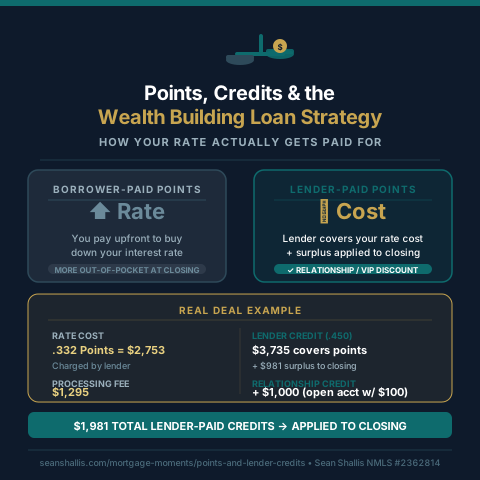
In this case, the rate carried a cost of .332 points. The borrower paid zero of it. Here's how that works.
What Are Mortgage Points?
A mortgage point is 1% of your loan amount. Points are the currency of rate pricing — the mechanism lenders use to express the cost of a given interest rate.
When you see a rate on a rate sheet, there's almost always a point value attached. A .332 point cost on an $830,000 loan means the lender charges $2,753.60 to deliver that rate. That cost has to go somewhere. There are two ways it gets handled:
You pay the points upfront at closing to buy down the interest rate. More out-of-pocket today, lower monthly payment for the life of the loan. This makes sense if you're staying long-term and have the cash.
The lender pays the points on your behalf, typically in exchange for a slightly higher rate — or as a relationship incentive. Any surplus beyond the rate cost gets applied directly to your closing costs.
I Don't Sling Loans and Rates
When I take on a client, I'm not handing you a rate sheet and asking which number looks good. My goal is to build what I call a Wealth Building Loan Strategy — structured around four objectives:
Lowest Possible Rate
Not just competitive — optimized. That means structuring the loan to hit the right program thresholds, including conventional loan limits where applicable.
Least Amount of Bank Fees
One processing fee. No junk fees, no origination padding, no surprises on the Loan Estimate.
Highest Lender Credits (Lender-Paid Points)
I push for the maximum lender credit available. Any surplus beyond covering the rate cost goes toward your closing costs — cash in your pocket at the table.
Lowest Down Payment (with purpose)
Keeping your cash working for you — not locked in equity. The right down payment is the one that optimizes your rate, your payment, and your liquidity.
How It Plays Out in a Real Deal
Here's a real example — a recent client transaction, with the math laid out exactly as I presented it:
The rate had a cost. The borrower paid none of it. The lender credit not only covered the .332 point cost — it generated a surplus of $981.76 that went straight toward closing costs. Add the $1,000 relationship credit from opening a basic account with $100, and the borrower walked in with nearly $2,000 in credits working for them before a single other closing cost was even discussed.
The Conventional Loan Limit Move
One more lever worth explaining: loan size matters for rate pricing. Conventional loans under the conforming limit ($802,650 in most of the country; higher in certain high-cost areas like parts of New Jersey) get better pricing than jumbo loans.
In this case, structuring the loan to stay inside the $832,500 limit — aligning with the client's expected down payment and payment goal — unlocked better rate pricing and kept the deal in conventional territory. That's not an accident. It's strategy.
The Point
Most borrowers focus on the rate number. A Wealth Building Loan Strategy looks at the whole picture: rate, fees, credits, loan structure, and down payment — and optimizes all of them at once. The goal isn't the best-looking rate. It's the best actual outcome.
The Bottom Line
Every mortgage rate has a cost. The question is whether you pay it — or the lender does. When you work with someone who has access to lender credits, relationship incentives, and the experience to structure a loan strategically, that cost can not only disappear but flip into money working in your favor at closing.
That's not a rate. That's a strategy. And that's the difference.
Mortgage Moments
Want to see what your deal could look like?
Ask Rosie for a free rate check — or book a call and let's build your Wealth Building Loan Strategy together.
Sean Shallis · Mortgage Loan Originator · NMLS #2362814. This post is for educational purposes only and does not constitute financial or mortgage advice. Loan scenarios, credits, and rate pricing are for illustrative purposes only. Actual rates, points, and credits vary based on loan amount, credit profile, property type, and market conditions. Contact Sean for a personalized analysis of your specific situation. Equal Housing Lender.