What Your Lender Actually Requires for Homeowners Insurance
It's not your loan balance. It's not what you paid for the house. Here's the one number that actually matters — and why confusing them is the most common gap in coverage.
A Question I Get Every Week
“Does the mortgage company have a minimum insurance requirement? How much homeowners insurance do I actually need?”
Yes — and the answer surprises most buyers, because it has nothing to do with what you paid for the house or what you owe on your loan.
Your lender requires one thing: enough coverage to rebuild the structure if it's destroyed. That's it. They want to know the asset they're financing can be put back together.
The Three Numbers Buyers Confuse
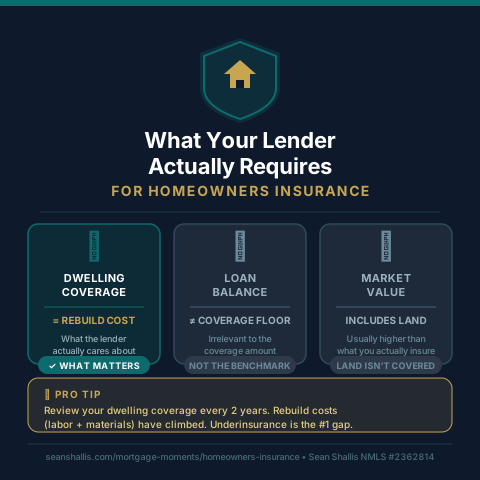
When it comes to homeowners insurance and your mortgage, there are three numbers in play — and most buyers conflate all three.
DWELLING COVERAGE
✓ What Matters= Rebuild Cost
This is what your lender actually cares about. How much would it cost to rebuild the physical structure from the ground up — labor, materials, permits? That's the number your dwelling coverage needs to cover. Not what you paid. Not what you owe.
LOAN BALANCE
Not the Benchmark≠ Coverage Requirement
Your outstanding mortgage balance is irrelevant to your insurance coverage requirement. If you bought a $600K home and owe $480K, the lender doesn't cap your insurance at $480K — they want enough to rebuild the structure regardless of what you owe.
MARKET VALUE
Land Isn't CoveredIncludes the Land
The price you paid for your home includes the land beneath it. Land doesn't burn down. It can't be destroyed by fire, wind, or water. So market value is almost always higher than your insurable dwelling value — and using it as your coverage number typically means you're over-insuring the structure.
A Real-World Example
Let's say you buy a home for $600,000. The land is worth roughly $200,000. That means the insurable structure — the thing that could actually be destroyed and rebuilt — is around $400,000.
Your lender doesn't require $600,000 in dwelling coverage. They require enough to rebuild the $400,000 structure. You owe $480,000 on your loan — but that number has nothing to do with how much insurance the lender mandates.
The rebuild cost is what drives the requirement. And that number comes from a replacement cost estimator, not the purchase price, not the appraisal, not the payoff amount.
What Happens at Closing
Before your loan closes, you'll need to provide proof of a homeowners insurance policy with at least enough dwelling coverage to satisfy the lender's requirement. Your lender will review the declarations page of your policy to confirm.
In most cases, your lender will also escrow your insurance premium — collecting a monthly portion alongside your mortgage payment and paying your annual premium directly from escrow when it comes due. It's one less thing to manage, and the lender is protected because the policy stays active.
🔑 Pro Tip
Review your dwelling coverage every two years. Rebuild costs — labor and materials — have climbed significantly over the past several years and continue to rise. Underinsurance is the most common gap in homeowners policies: your coverage was right when you bought, but the cost to rebuild has outpaced the coverage amount. A quick call to your insurance agent to request a replacement cost update takes 15 minutes and could save you from a six-figure shortfall.
The Bottom Line
Your lender's insurance requirement is simpler than most buyers expect: cover what you can actually lose. The structure. The rebuild. Not the land, not the loan balance, not the purchase price.
Get a replacement cost estimate from your insurance agent, make sure your dwelling coverage meets or exceeds it, and revisit that number every couple of years as costs change. That's the requirement — and it's also just good financial hygiene.
Mortgage Moments
Questions about your specific situation?
Insurance, escrow, coverage requirements — every deal has nuances. Ask Rosie for a free check or book a call and let's walk through your numbers together.
Sean Shallis · Mortgage Loan Originator · NMLS #2362814. This post is for educational purposes only and does not constitute financial, legal, or insurance advice. Insurance requirements vary by lender, loan type, and property. Consult your insurance agent and mortgage advisor for guidance specific to your situation. Equal Housing Lender.